Scout / A personal AI job-search service

First,
understand you.
Then, find the role.

Your experience. What energizes you. How you work best. Scout turns that understanding into a search built around you, then finds and reads the roles worth your attention.

For Director-to-VP leaders in data, product, marketing, and technology. For an active search or a quiet look at what could come next.

Invite-only · Set up personally with Jimmy · Runs every weekday.

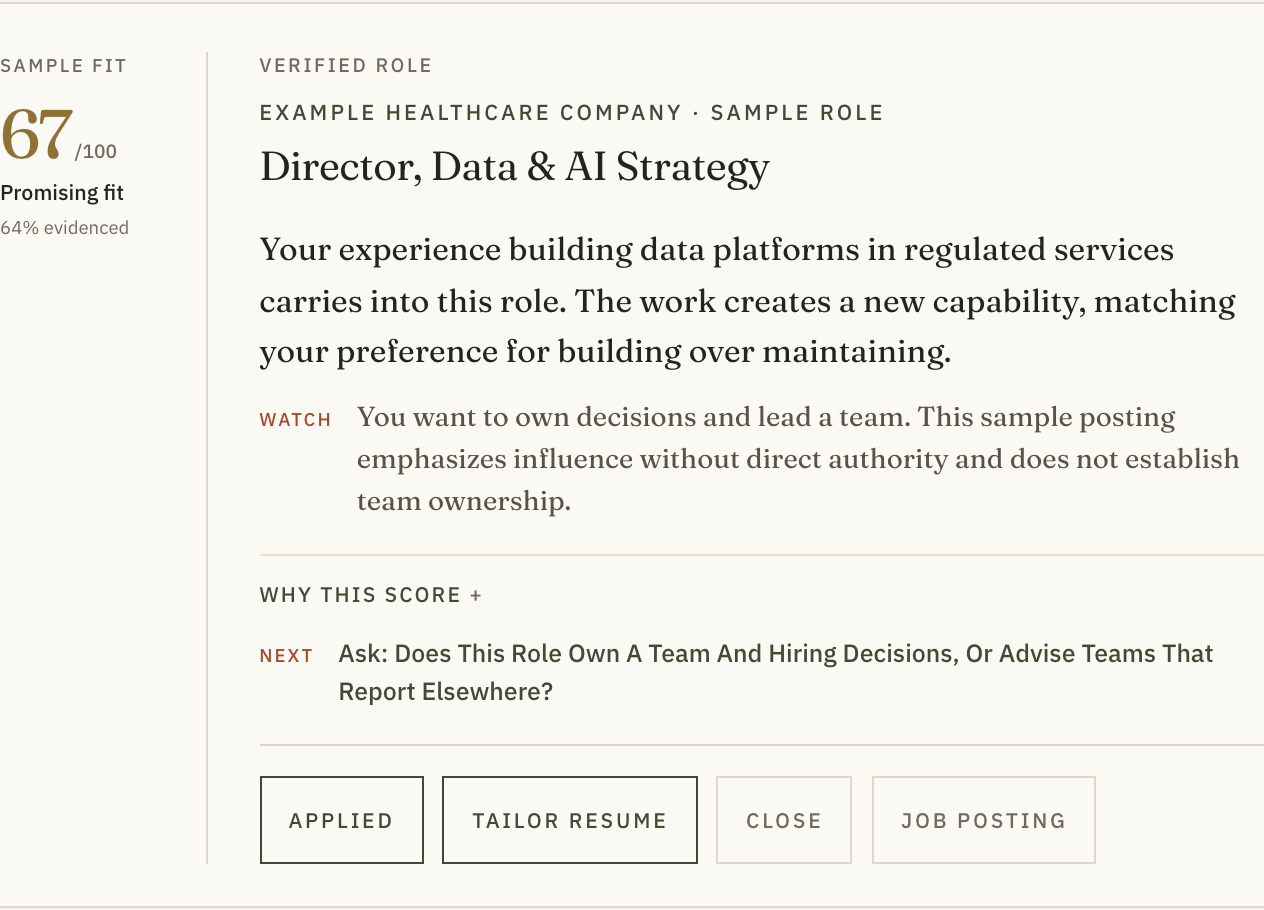
Scout’s role review for a fictional applicant: a fit score of 67 out of 100, why the role fits, what to watch, and the next question to ask.Enlarge
One verified role, read against the sample profile: the fit, the reason, and what to watch.Actual Scout interface · Fictional demonstration data.

How the AI works

Your profile sets
the search in motion.

AI helps turn your experience into a search brief, explores the market, and reads the roles it finds through that brief. You get the reasoning behind the recommendation.

Follow the work. Choose any part to look inside.

01 / Understand the personA brief built
around you.
03 / Bring back a considered readRead the role.
Remember the person.

Your decisions inform the next search. The brief stays editable as your priorities change.

AI + human review

An editable brief that the search can use.

During setup, AI helps turn your resume and the context you share into a scouting profile: your experience, motivations, working style, and constraints. Jimmy works through it with you.

That profile sits alongside your resume and explicit search settings—geography, role vocabulary, recurring searches, and target boards. You can inspect and change them.

Output: your profile, resume, and search configuration.

Back to the diagram ↑

Direct collection

Read the employer’s published openings directly.

Scout retrieves job listings from configured company boards using supported feeds and posting endpoints. These include Greenhouse, Lever, Ashby, and Workday.

Location and role-language filters narrow the pool. Some sources are checked each run; others rotate. A newly discovered employer board can add more openings to the same run.

Output: postings and descriptions from known sources.

Back to the diagram ↑

AI + web search

Let AI propose where else to look.

The planning model reads your profile, resume, search history, and feedback. It generates search ideas around related business problems, unfamiliar titles, industries, and organizational changes.

Web search retrieves results. AI extracts candidate roles from those sources, and supported posting links can lead Scout to additional company boards. Configured recurring searches run alongside these fresh ideas.

Output: new candidate roles and employer boards to inspect.

Back to the diagram ↑

Code + AI triage

Establish what is there before judging it.

Scout retrieves the full description and looks for evidence that the job is open, using the employer feed or posting page. It checks eligibility and previous results so closed or repeated roles do not become fresh recommendations.

An initial AI pass prioritizes evidence-rich roles for deeper review. That pass orders the queue; it does not reject roles. Work deferred by run limits can carry into a later run.

Output: a verified, prioritized review queue.

Back to the diagram ↑

AI + fixed scoring

Give the model the person and the posting.

The evaluation model receives the role’s source material alongside your saved scouting profile. It assesses the work, authority, team, leadership, breadth, and operating conditions, marking evidence as direct, inferred, or unknown.

Code combines those ratings using fixed weights. Fit and evidence coverage remain separate. A later application review asks a different question: what your documents can actually support.

Output: a fit assessment, its evidence, concerns, and open questions.

Back to the diagram ↑

Your decision

Bring the reasoning back to you.

Roles that pass the publication checks and configured fit threshold reach your private board. A labeled below-threshold audit sample can also appear so the filter stays open to inspection.

You decide what to pursue. Closing a role preserves that decision; history and feedback inform later searches and assessments. You can also edit the profile or targeting as your priorities change.

Output: a shortlist you can question, act on, and refine.

Back to the diagram ↑

The process, made personal

What that looks like
for one person.

A sample profile shows what Scout reads. One real search shows what it found: a hundred roles, many titles, two paths.

Your profile

Turn that understanding
into a search strategy.

Your profile defines what good work looks like for you. Your search configuration translates it into where to look: relevant fields, levels of responsibility, locations, companies, and exclusions.

The configuration also sets recurring searches, target company boards, and a fit threshold. Together, profile and targeting give Scout a direction and a basis for judgment. You can review and update the configuration as your priorities change.

Sample scouting profile
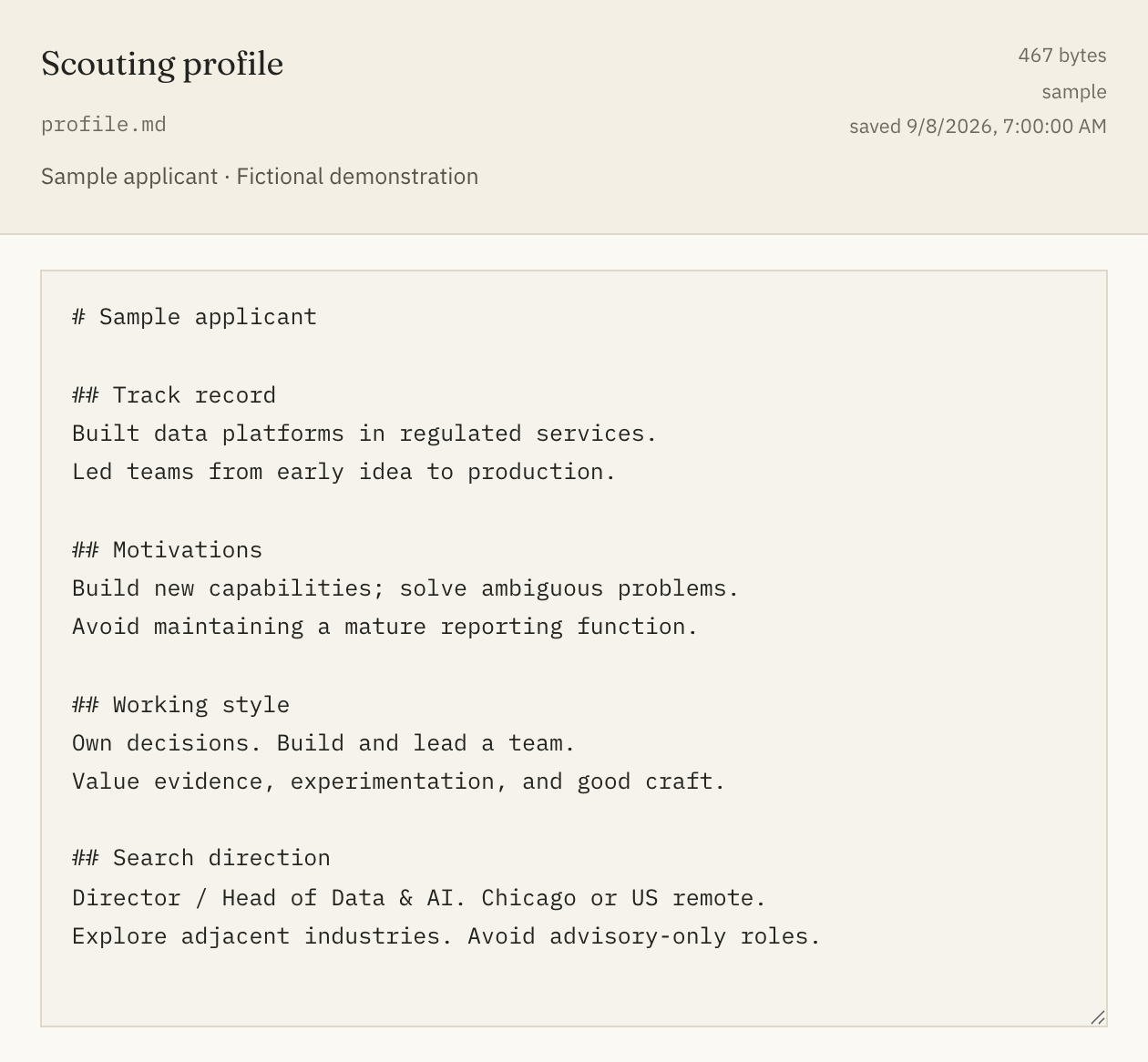
Scout’s profile editor with a fictional applicant’s track record, motivations, working style, and search direction.Enlarge scouting profile
One sample applicant. The preferences that guide the search.Actual Scout interface · Fictional demonstration data.
Read the sample as text
Track record
Built data platforms in regulated services. Led teams from early idea to production.
Motivations
Build new capabilities; solve ambiguous problems. Avoid maintaining a mature reporting function.
Working style
Own decisions. Build and lead a team. Value evidence, experimentation, and good craft.
Search direction
Director / Head of Data & AI. Chicago or US remote. Explore adjacent industries. Avoid advisory-only roles.
Your role review

Read each role
through your priorities.

Scout brings your scouting profile into the assessment. The title is the least reliable part of a posting, so it reads what the role actually asks for: the work, decision-making authority, team, leadership, and operating environment.

You see why the role could fit, what might make it wrong, and what the posting leaves unanswered. Whether you would enjoy the work stays separate from how well your experience supports an application.

Your decisions

Two paths.
Your call.

A resume proves what you have done. It rarely says which direction you want next, and most searches decide for you, usually the one your last title suggests. Scout reads the resume for every credible path and finds roles on each.

Below, one real search. The same resume supported two paths, and Scout surfaced both. Say which one you want, or close what you don’t, and the search narrows to it. Your stated preference outranks anything Scout infers.

One resume → two paths → your call

From the resume alone

  • Built the functionEnterprise data and AI, from a legacy state.
  • Shipped AIInto production, in a regulated setting.
  • Owned the callsBuild or buy, vendors, architecture.
  • Grew a teamFrom a first hire onward.
  • Governed AI useAcross compliance, audit, legal, and security.

No preference was set, so Scout searched both paths.

Path A

Build the function, own the calls, grow the team.

Path B

Set the rules, chair the council, manage the risk.

Both are honest readings of the same resume. Scout found roles on each and named the open question: unclear if he wants to narrow scope to governance alone. One answer, and the search follows it.

Roles Scout found on path A

  • VP, Data Strategy & Quality
  • Director, AI Technologies
  • Executive Director, Business Transformation
  • VP, Insights and Analytics
  • Director, Data Modernization
  • Senior Director, AI Operations
  • Director, AI and Innovation
  • Vice President, Data
  • Director, AI Engagements
  • Director, AI Center of Excellence
  • VP, AI Transformation & Enterprise Architecture
  • Enterprise Data Analytics & AI Transformation Director

Roles Scout found on path B

  • Director, Data and AI Governance
  • AI Governance Consulting Director
  • Senior Director, AI, Governance and Strategy
  • VP, Data Governance
  • Senior Manager, Data & AI Governance
  • Head of Data Governance
  • Director, AI Governance
  • Director, AI Governance & Business Integration
A hundred roles read for one person. Two paths from one resume, both real, both searchable.From one real search, a data and AI leader · Titles shown, employers omitted.

Want to see this for your own search?

Request access

What you get

A search you can
act on.

The research arrives with context, so you can spend your attention deciding what deserves a conversation.

Your private board

Roles, with the reasoning.

Review the fit, concerns, and open questions in one place. Create a tailored resume from your verified source material when you’re ready to make your case.

Your inbox

A search that keeps moving.

Role emails bring new opportunities that clear Scout’s review. The Monday brief adds sourced market context and questions for your next conversation.

Request access

A Scout of your own.

Send your resume and a sentence about your next move. Jimmy will reply personally.

Or write to jimmy@auncollective.com with your resume attached.

  1. Talk through your search.

    Explore your experience, motivations, working style, and what you want from your next role.
  2. Jimmy sets up your Scout.

    Together, your scouting profile and search configuration become the foundation for your private instance.
  3. Review it, then start scouting.

    Sign in, check what Scout understands about you, and refine the direction. Your searches run from that configuration. Everything is hosted; there’s nothing to install.

Scout is invite-only. There is no public price yet; pricing is discussed with Jimmy once he understands your search.

Sample scouting profile

Actual Scout interface · Fictional applicant and role.

Scout’s profile editor with a fictional applicant’s track record, motivations, working style, and search direction.
Read the sample as text
Track record
Built data platforms in regulated services. Led teams from early idea to production.
Motivations
Build new capabilities; solve ambiguous problems. Avoid maintaining a mature reporting function.
Working style
Own decisions. Build and lead a team. Value evidence, experimentation, and good craft.
Search direction
Director / Head of Data & AI. Chicago or US remote. Explore adjacent industries. Avoid advisory-only roles.

Sample role review

Actual Scout interface · Fictional applicant and role.

Scout’s role review connects the same applicant’s building experience to a role and flags unclear team ownership.
Read the sample as text

Example healthcare company · Sample role. Director, Data & AI Strategy.

Illustrative fit: 67/100, promising fit. Evidence coverage: 64%.

Why it fits
Your experience building data platforms in regulated services carries into this role. The work creates a new capability, matching your preference for building over maintaining.
What to watch
You want to own decisions and lead a team. This sample posting emphasizes influence without direct authority and does not establish team ownership.
What to ask
Ask: Does this role own a team and hiring decisions, or advise teams that report elsewhere?