Thought 008 · Comic · 2 min · July 29, 2026

What have you stopped doing?

The gain isn’t the tool. It’s the step that stops happening.

On Google’s ATLAS report, Robert Solow, and a faster rewinder.

Google released a new report — ATLAS, 15 million interactions analyzed to see how and where AI is actually used.

It opens with a 1987 quote from Robert Solow: you can see the computer age everywhere but in the productivity statistics.

Intrigued by his point I asked AI to elaborate — US labor productivity had grown about 2.9% a year from 1948 to 1973. Then it roughly halved and stayed there for two decades, which is exactly the stretch when computers were spreading through every office in the country. A lot of money going in, and not much showing up on the other side.

Then around 1995 it turned. Growth came back to about 2.7% a year and held there for about a decade.

Which raises the question. Do the gains come from the additions or the subtractions?
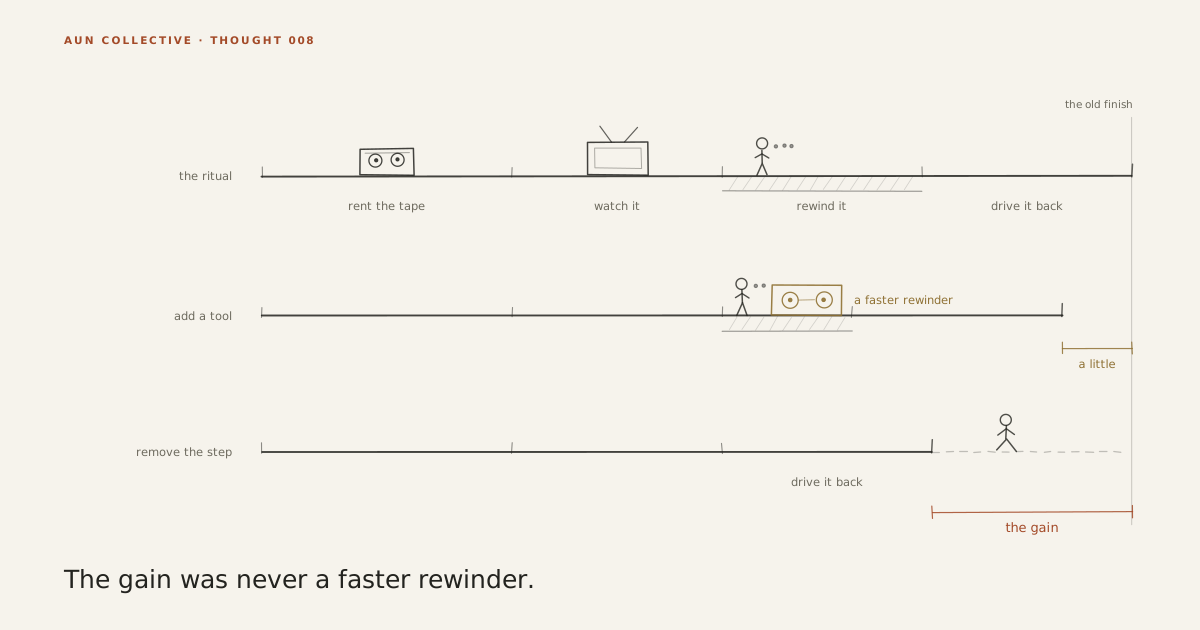
A drawing in three rows on one shared axis. In the first row, the ritual: a video cassette, a television with rabbit ears, and a person standing and waiting sit on a line divided into rent the tape, watch it, rewind it, and drive it back, with the rewind segment hatched. In the second, add a tool: a small rewinder machine sits on the line, the rewind segment is a little shorter, the person is still standing there waiting, and the line falls slightly short of the shared end mark. In the third, remove the step: the rewind segment is gone, the line closes up and stops well short of the end mark, the person walks off the end of it, and the reclaimed span is dimensioned in clay and labelled the gain.
Be kind, rewind.

My hunch is subtraction.

Take a doctor typing notes while you’re talking. Let AI take the notes and you’ll see a gain — but the tool doesn’t create the gain. The gain is the typing that stops happening, assuming that time goes somewhere useful — like working with the patient.

Is AI adding or subtracting for you?

Source behind the reading

The report is Google’s AI & Economy ATLAS v1.0 (July 23, 2026) — roughly 15 million de-identified interactions across the Gemini App, Google AI Mode, and the Gemini API, sampled April 6–19, 2026, and mapped to occupations, tasks, household activities, countries, and languages. Google’s own summary of the report is the shorter way in.

Robert Solow’s line — that you can see the computer age everywhere but in the productivity statistics — comes from a 1987 book review, and the ATLAS authors open with it.

The productivity figures came out of the AI conversation and were checked afterwards against BLS labor productivity for the nonfarm business sector. They hold. One note on precision: BLS’s published long-run figure for 1947–1973 is 2.8% a year; depending on the sector series and the endpoints you choose, the post-war rate lands between 2.8% and 3.0%. The slowdown and the 1995 turn are not close calls — growth ran 1.2–1.5% a year from 1973 through 1995, then about 2.7% a year for the following decade.

How this was made

This started with the ATLAS report and the Solow line inside it. I asked AI to elaborate on the paradox, then went to BLS to check the numbers rather than take them. The paper itself was read in full and argued through in conversation with Claude Cowork (Claude Opus 5), July 2026 — it read, I pushed, and several of its suggestions did not survive. The reading, the hunch, and the words published here are mine. The line drawing is SVG, plotted in the site’s palette and type — no photography and no image generation.

← Back to Thoughts